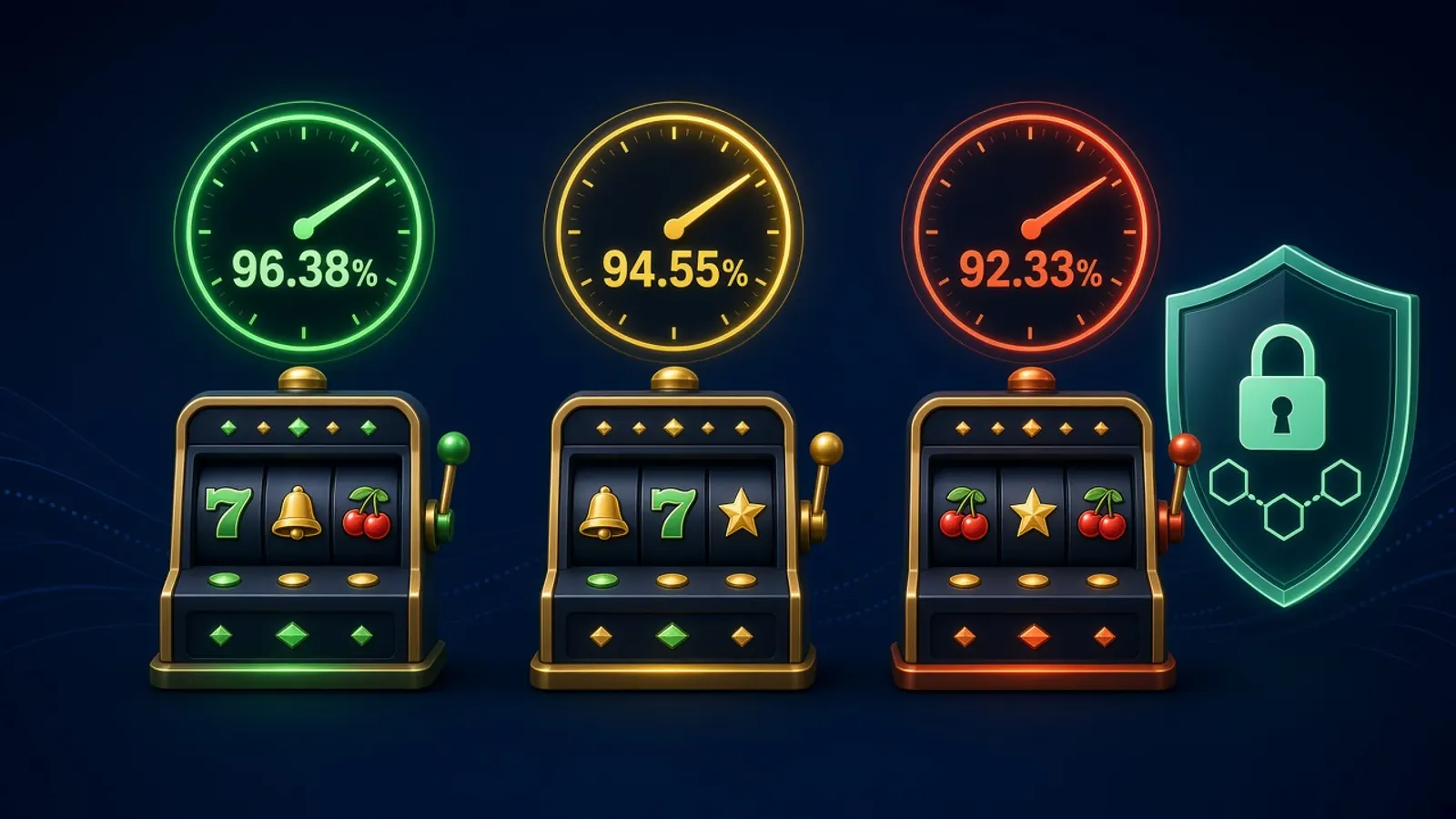
Same Slot, Different RTP: Why the Casino's Setting Matters (and What Provably Fair Proves)
One slot title can ship in several RTP settings. The casino chooses which one runs. Provably fair can prove an outcome was not changed after the bet. It does not prove the RTP.
The title on the tile can be the same while the long-run return is not. The RTP that matters is the one in the rules of the copy you opened.
This is a follow-up to how slot RTP works. That piece covers what a published RTP is: a long-run theoretical average over very many spins, not a forecast for one session. This piece is about a narrower fact. Many studios do not ship a slot as a single RTP. They ship the same game in several settings, and the casino chooses which setting it runs.
One title, several published settings
A studio can build one math model and then issue more than one return figure for it. The reels, the name, and the feature list can look the same in the lobby. The percentage in the help file does not have to. Marketing often quotes the highest figure the studio published. The casino is free to run a lower one.
That is not a hidden trick unique to one brand. It is how a lot of third-party slots are distributed. The practical consequence is simple: a review, a screenshot, or another casino's lobby is not proof of the RTP in the game you just opened.
The Wanted Dead or a Wild figures
Hacksaw Gaming publishes four RTP versions for Wanted Dead or a Wild: 96.38%, 94.55%, 92.33%, and 88.42%. Those numbers are on the studio's game data. They are not measurements we made, and they are not a ranking of casinos. Any of them can be the one a lobby is running.
The same game page lists a max win of 12,500x the bet and volatility of 4/5, which is high. Those two facts stay in the conversation because a lower RTP version does not remove the cap or the volatility. You can be on the 88.42% setting and still see the 12,500x figure in the rules. The cap describes the largest result the game can pay. The RTP describes the long-run average. They answer different questions.
An example, not a session
The gap is easier to see with arithmetic, so here is an example. It is not a recommended stake, not a recorded result, and not a promise about what a night of play returns. Take $10,000 of total wagered amount, the sum of bets over a very long run, not a balance you should deposit.
- At 96.38%, the expected return is $9,638. The expected loss is $362.
- At 94.55%, the expected return is $9,455. The expected loss is $545.
- The difference is $183 more expected loss on the lower setting.
- At 88.42%, the expected return is $8,842. The expected loss is $1,158.
- Against the 96.38% setting, that is about $796 more expected loss.
Those differences are 1.83 and 7.96 percentage points of the $10,000 example. They are long-run averages. A short session can finish above or below any of them, including a large win on the lower RTP version and a total loss on the higher one. The point of the example is only that the setting is not cosmetic. Across a large amount wagered, the version the casino selected moves the expected loss by hundreds of dollars in this illustration.
92.33% sits between the two comparisons above. The same style of arithmetic applies. This article does not need a third worked example to make the point: read the figure on the copy you opened, and do not borrow it from somewhere else.
Where the figure is shown
Open the game's info or rules screen before you spin. That screen is where the operator's chosen RTP is supposed to appear. If the screen is missing, or the percentage is not there, you do not know which of the published versions you are on. A tile in the lobby that says the studio name is not a substitute.
Check it again if you came from a review or a clip. Those sources often repeat the best-known figure, which for this game is 96.38%. Repeating it is accurate as a published version. It is not accurate as a description of every casino that lists the title.
What provably fair proves
Players sometimes treat "provably fair" as proof that the RTP is the one they hoped for. It is a different tool.
In the usual setup, the casino commits to a server seed by publishing a hash of it before the bet. The result is then built from that server seed, a client seed, and a nonce. After the bet, the casino can reveal the server seed. You hash it and check that it matches the commitment, then you recompute the outcome. If it matches, the outcome was not changed after you placed the bet.
That check does not tell you the RTP. It does not tell you the house edge. A game can be provably fair and still be the 88.42% version, or any other edge the operator configured. Fair, in this narrow sense, means the revealed result matches the committed inputs. It does not mean the game returns 96% or that a max win is due.
Provably fair mostly applies to a casino's own originals, such as dice, crash, and plinko, where the operator can show the seeds. It does not, in general, apply to third-party studio slots. A Hacksaw game is a studio slot. Seeing a provably fair checker on the casino's dice game does not extend that proof to Wanted Dead or a Wild, and it does not identify which RTP version the slot is using. Our provably fair guide covers the verification steps. Use it for what the tool actually checks.
What to do with this
Read the rules screen of the game you opened. Compare that percentage with the versions the studio published, if you know them. Treat a higher published RTP as a long-run comparison, not as a reason to stake more. A lower setting is still a game of chance with a house edge, and a higher setting still loses in the long run by the amount of that edge.
If you want the longer explanation of why a session does not track the percentage, go back to how slot RTP works. The setting only tells you which average the math is aiming at. It does not tell you the next spin.
Where to play
Offers below are the lines already stored for these casinos. Check the lobby before you deposit.

Crypto Loko
Featured
505% bonus + 55 free spins. Free spins on registration.

BitStarz
150% up to 5 BTC + 200 free spins. 20 free spins no deposit.

7Bit Casino
100% bonus up to 1 BTC + no deposit bonus.
18+ | Gamble responsibly. T&Cs apply.
Play only if you can afford to lose
Slots are games of chance. The published math includes a house edge. Set a limit before you start, and stop when you reach it. If gambling is no longer fun, or you are chasing losses, take a break and use help if you need it. Our responsible gambling page has more on that.
18+ Gamble responsibly. Please gamble responsibly. Set limits and never bet more than you can afford to lose.